🎯 Executive Summary
This research report presents six actionable SEO testing strategies that can significantly boost organic traffic. Each experiment includes real-world case studies demonstrating measurable improvements in click-through rates (CTR), rankings, and overall traffic. From title tag variations and meta description optimization to internal linking, schema markup, and content restructuring, the findings reveal how small, data-driven changes can yield substantial SEO gains. The study also provides additional test ideas for ongoing experimentation.
🔬 Research Background
SEO testing involves systematically experimenting with different on-page elements to understand what drives better search performance. Unlike broad SEO advice, these tests isolate variables to measure direct impact—making them ideal for evidence-based optimization. This report compiles proven experiments from industry leaders like Search Pilot, PageOptimizer, and Typeform, showing how even minor tweaks can lead to major results.
📈 Key Findings
Finding 1: Title Tag Optimization Drives CTR Gains
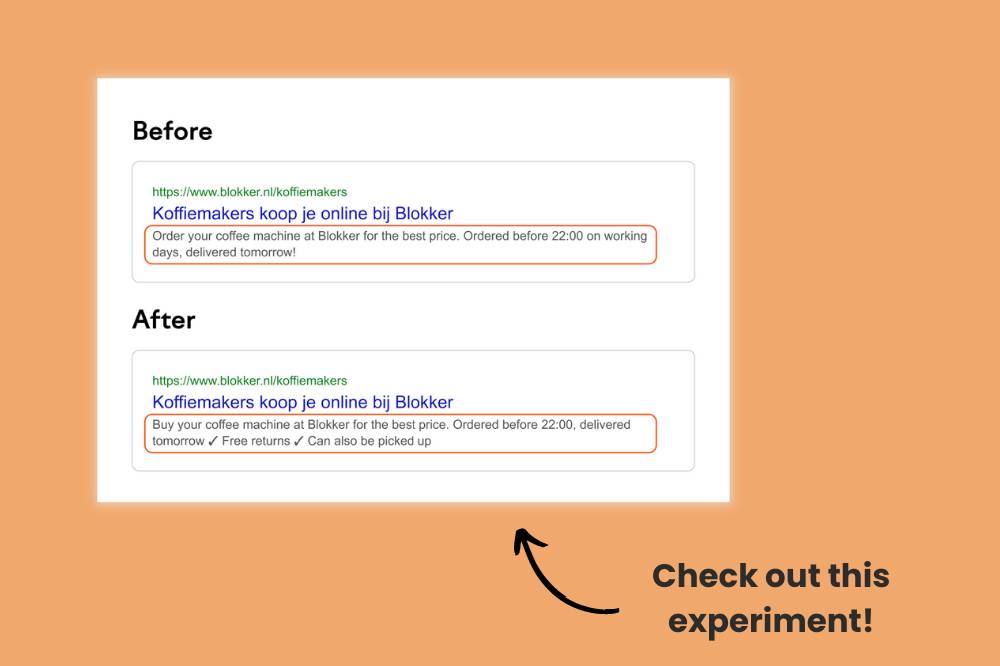
Testing short vs. long titles, keyword placement, brand inclusion, negative superlatives, numerals, and action words revealed that emotional language and clarity outperform generic tags. For example, adding "✓Free returns ✓Can also be picked up" increased clicks by 6.5% in one e-commerce test.
Finding 2: Meta Descriptions Matter More Than You Think
A Dutch e-commerce site saw a 6.5% increase in CTR by refining CTAs and adding unique selling points (USPs). The test reached 95% statistical significance in just eight days, proving that well-crafted descriptions directly influence user behavior.
Finding 3: H2s Beat Multiple H3s in Rankings
An experiment comparing one optimized H2 against two H3s found that Google prioritizes higher-level headers. Even with more keyword-rich H3s, the page dropped in rank—showing that header hierarchy matters for SEO.
Finding 4: Internal Linking Boosts Traffic Across Pages
Adding links between category levels on a grocery site led to a 25% uplift in organic traffic across both level-two and level-three pages—an estimated 9,200 extra sessions per month.
Finding 5: FAQ Schema Increases Click-Through Rates
FAQ schema was the most consistently positive change across all tests (67% success rate), with some cases seeing up to 25% traffic increases. While Google limits rich snippets per result, FAQs remain highly effective.
Finding 6: Content Structure Impacts Dwell Time and Rankings
Typeform’s article moved from page 2 to position 3 in under an hour by replacing a narrative intro with a bullet-point summary of findings. This immediate alignment with search intent improved dwell time and boosted visibility.
💭 Analysis & Implications
These experiments highlight that SEO isn’t just about keywords—it’s about understanding user intent, improving clarity, and optimizing for both humans and algorithms. Small changes in structure, tone, and presentation can have outsized effects because they signal relevance and quality to search engines. Moreover, many of these tests require minimal effort but offer high ROI, making them perfect for teams looking to scale their SEO efforts efficiently.
🚀 Conclusions & Recommendations
To maximize SEO impact: - Test title tags and meta descriptions regularly—they’re low-effort, high-reward. - Prioritize header hierarchy; don’t sacrifice H2s for multiple H3s. - Build strong internal linking paths to distribute PageRank and improve crawlability. - Implement schema markup strategically—FAQs are especially powerful. - Revisit content structure frequently—clear, intent-aligned intros drive engagement.
For continuous improvement, run at least one test per month using tools like SplitSignal or Google Optimize. Track metrics like CTR, impressions, rankings, and dwell time to measure real impact.
Sources
Play
Thanks for providing the link. However, please specify which specific article or topic you'd like a summary on regarding reactions and opinions. This will help focus the analysis on the relevant content.